New Year, New Goals: Secrets to Setting (and Sticking To) Goals
December 11, 2023|
Alfred Music Official

Isn't it helpful how the end of the calendar year coincides with the midpoint of the school year? Now is the time to check in with yourself about how things are going and how you want them to change. In order to do that, let's revisit your vision, set SMART goals, and map out a plan for how to make it happen.
Set Goals Instead of Making Resolutions
Forget making resolutions this year! After all, how often have resolutions actually been effective for you? Let's go out on a limb and assume the answer is "not very often." There is a better way! A resolution usually consists of a broad and undefined statement of what you hope will happen. Instead, set a SMART goal, and you will have created a roadmap for real change.
Revisit Your Vision
Clear away all your thoughts and feelings about the current school year. Get back in touch with your original "why" so you can align your goals with your values. If you have a personal vision statement or mission for your teaching, now is the time to evaluate it. If you don't, here are some questions to ask yourself to develop your vision:
- Why did I originally want to be a teacher?
- What am I passionate about?
- What activities or experiences bring me joy?
- What do I think the role of a teacher should be?
- How does my teaching impact my students and community in a positive way?
- What do I want learning to look like in my classroom?
- How should students feel while they are in my classroom?
Now, look for a general area you need or want to improve. Here are some ideas for the types of professional teacher goals you may want to set:
1. Increase differentiation. Students learn in different ways. Are you tailoring your teaching methods and materials to meet their individual needs? Differentiated instruction ensures that all students are engaged in the learning process, which can lead to improved motivation and achievement. One method for differentiating is phygital learning (the blending of digital with physical experiences). Phygital learning allows students to move at their own pace, in a variety of settings, and with personalized instruction. MakeMusic Cloud is a powerful tool for incorporating phygital learning. MakeMusic Cloud is a powerful tool for incorporating phygital learning—explore the expansive Music Catalog to reinforce skills you are working on in class with print music and methods (check out Sound Innovations Extras for some extra fun extension lessons), track student progress, utilize Compose to offer unique and personalized differentiation to students, and so much more. Try MakeMusic Cloud’s full suite of powerful tools free for 30 days .
2. Elevate sight reading skills. Strengthening sight reading skills not only enhances musicianship but also cultivates a lifelong love and understanding of music. Are you implementing a consistent and sequential system for sight reading practice? Make it a goal to establish a new routine or to find ways to energize your current one. Take a look at Sight Reading Studio —it's available as a standalone subscription or as part of the MakeMusic Cloud platform.
3. Implement Social-Emotional Learning. Now is the time to plan for a consistent and integrated SEL practice in your classroom. SEL can improve behavior, mood, accountability, stress levels, and so much more. How will you weave these strategies into your teaching? Look for guidance from a course or workshop, and get ideas from resources like The Mindful Music Classroom: Practical Strategies for Social-Emotional Learning .
4. Cultivate relationships with other teachers and musicians. Anyone from a first-year teacher to an experienced veteran can benefit from getting to know colleagues. Whether you are sharing your expertise or learning from someone else's experiences, these relationships are important in building up your community. Seek out professional organizations to join, audition for a community ensemble, or collaborate with another teacher in your area.
5. Get organized. Organization can help you get more done in less time, and demonstrating these skills to your students is invaluable. The key to making it happen is to identify specific target areas:
- Organize your resources. Set yourself up to be able to find files, instruments, tools, and music easily. Look into apps and platforms like Dropbox or Google Drive to manage your digital files, including PDF scores and MP3 tracks.
- Organize your time. Get serious about setting a schedule and prioritizing activities by implementing a proven strategy. Look into the Eisenhower Matrix, Pomodoro Technique, and Timeboxing.
- Organize your space. It's difficult to focus, learn, or teach in a cluttered space. Get your physical space in order using principles from the KonMari Method, or try the 12-12-12 Challenge.
6. Look for professional development opportunities. Whether it's required for your position or not, it should be a goal to seek out conferences, webinars, clinics, and other training opportunities. Plan ahead by getting these events on your calendar and being intentional about attending or viewing. Check out the Alfred Music events page to see what and where our clinicians will be presenting. We also offer professional development sessions for school or district in-service days—find out more on our website .
7. Change your mindset. Changing how you think about your teaching can be one of the most significant ways to impact it. Your mindset will determine, to a large extent, how much you will grow and feel fulfilled. Here are some ways you can systematically work toward developing a healthier mindset:
- Read. Numerous books are available that focus on mindset, and many are specifically for teachers. One example is Awakened: Change Your Mindset to Transform Your Teaching by Angela Watson.
- Journal. Journaling has been proven to have many positive effects. It can help you understand yourself better, evaluate your growth, release stress, and remove mental blocks. The journal can be as simple as an empty notebook or a published journal with prompts. A Music Teacher's Gratitude Journal is written especially for music teachers and includes inspiring quotes, habit trackers, and simple yet insightful writing prompts.
8. Improve classroom management skills. Even the most creative and lovingly created lessons will be ineffective if you don't have a handle on classroom management. Get inspiration from expert teacher Scott Watson's article on classroom management for ensemble directors ( Part 1 and Part 2 ).
9. Get parents more involved. Keeping parents and guardians supportive and involved in your program can have many benefits. Set a goal around increasing parental participation. Do you need chaperones for field trips? Want some assistance with fundraising? Do you want to start a music booster organization? Is there an opportunity for them to perform with their child?
Creating Your SMART Goals
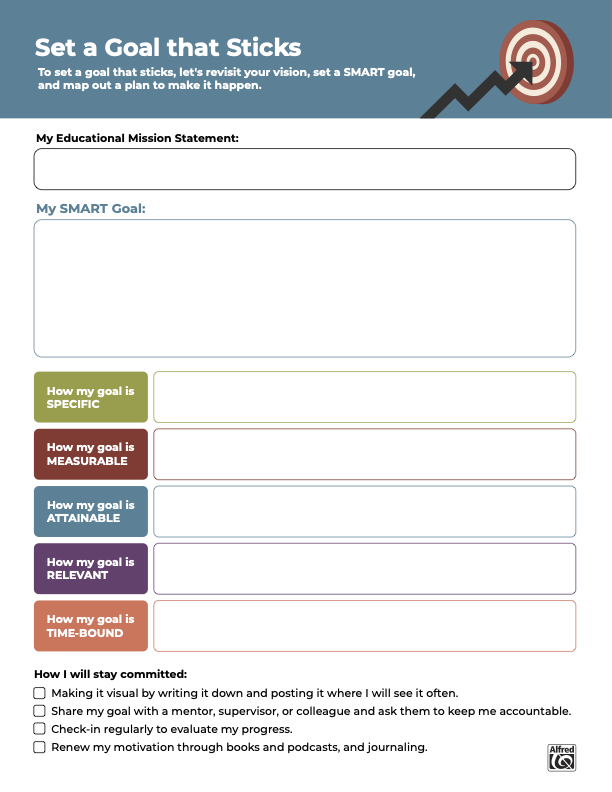
SMART goals help you improve your chances of succeeding in achieving your goals. This technique will focus your attention on a specific objective and provide a structure for working toward it. SMART is an acronym for:
Specific — What goal are you trying to accomplish? Why? What will you do? Does your goal target a specific area for improvement?
Measurable — What’s your intended outcome? How will you know you’ve achieved your goal? Can you accurately measure your goal? What data will you use to decide whether you've met the goal?
Achievable — Is your goal realistic? What actions will you put in place to ensure you achieve it? Are you sure you can do this? Do you have the right skills and resources?
Relevant — Is the goal relevant to you? How does your goal align with your role as an educator? How will the result matter?
Time-bound — What is the specific timeline? What is the deadline for accomplishing the goal?