
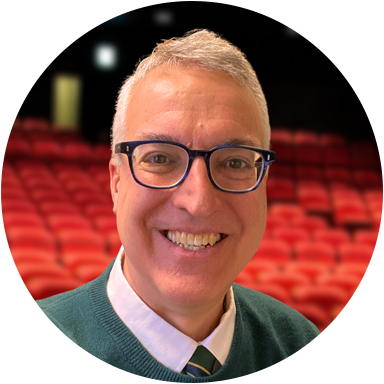
Scott Watson
Dr. Scott Watson is Associate Professor of Music at Cairn University (Langhorne, PA). For 35 years prior, he was an instrumental and elective music teacher in the Parkland School District (Allentown, PA), first as high school Director of Bands, then as coordinator of the elementary band/strings program across the district. An award-winning and frequently commissioned composer, his unique voice - evident in more than 120 published concert band, string orchestra, and chamber works at all levels—is informed equally by his experiences with contemporary concert art music and the band world. Watson’s music has been performed around the world and in the U.S. at such prestigious venues as the Academy of Music (Philadelphia), the Midwest Clinic (Chicago), and the White House (Washington, D.C.). He is an exclusive composer/clinician for Alfred Publications and a contributor to their Sound Innovations band series. Watson has presented numerous workshops/clinics for music educators, frequently serves as guest conductor/clinician for honor/festival bands, and is the author of the highly regarded music education text, Using Technology to Unlock Musical Creativity (©2011, Oxford University Press). To learn more, visit www.scottwatsonmusic.com.
Clinic Offerings
Banding Together: Incorporating Outside Help for Your Program
You don’t have to do it all! In this session, veteran music educator and composer Dr. Scott Watson shares ideas and strategies for enlisting the valuable contributions of colleagues to help your students and you, especially on a tight budget. Topics include guest director rehearsal clinics, composer visits, virtual instrument masterclasses, publisher resources, and online professional learning networks.
Black Dots on a White Page: Commissioning a New Work
Ever wondered about the nuts and bolts of making a commission happen? From initial composer contact to agreements/contracts to tips for collaborating with the composer, Watson shares details for bringing a new work – written especially for you – to life! Includes many creative ways to fund your commission!
Building a Culture of Excellence in Your Program
Looking for ways to encourage and nurture the members of your music program team? This session shares strategies in five key areas—Time, Effort, Proficiency, Relationships, and Creativity—that foster a culture of excellence throughout your department/district. When excellence becomes the “air” your staff and students breathe, all aspects of your program benefit as a result.
Building Your Base: Recruitment/Retention Tips for Your Band/Orchestra Program
Drawing on more than three decades of experience in the Parkland School District (Allentown, PA), first as high school band director, then as coordinator of elementary instrumental music (comprising 900 band/strings students in 4th/5th grade), Dr. Scott Watson shares a host of practical, proven ways to maximize recruitment and retention efforts, including the role of creating a positive band culture in your building.
Composing and Arranging for School Bands
There are many great reasons to compose and arrange for your own ensemble; no one knows your band and its abilities better than you! This session is designed to help those with an interest in writing for school bands take their music to the next level of effectiveness and professionalism while expanding the audience for their music. Topics include the art and craft of composing/arranging, the conventions of writing at various levels (elementary, intermediate, high school and beyond), criteria related to the grading system (Grade .5 through 6 scores and instrumentation, ranges, rhythms, doubling, etc.), commissions, and tips for submitting music to publishers.
Creativity in Band and Orchestra
The primary focus in instrumental music ensembles is RE-CREATING the music of others by playing proficiently. Nonetheless, there are compelling reasons to incorporate CREATIVE activities with these students. In this session, composer and educator Dr. Scott Watson draws on decades of experience working and sharing with students of all ages to provide tips and activities for unlocking the creativity of students in band and orchestra. Topics range from an interactive, large-group activity (“The Craft of Composition”) to ensemble (“Just Add Music”) and individual (“Pedal Point Duet”) composition projects, geared toward students from beginners to high school.
Dynamic Concerts: Audience and Student-Friendly Ways to Enhance Performances
Strong musicianship is essential, but what makes a concert unforgettable for students and audiences? This session offers practical ways to add musical and extra-musical elements that turn performances into dynamic, “must-see” events. Discover strategies that boost student enjoyment, audience connection, and community support while building pride, aiding recruitment/retention, and making your concerts highlights of the school year!
Finding and Exploiting Patterns in Music
When we can uncover patterns in music, students can anticipate what’s coming and learning that music becomes easier. Much music of lasting worth is written with multiple patterns of organization. Whether it’s the canonic or imitative counterpoint of Bach, the symmetrical phrasing of Mozart, the Fibonacci series embedded in note groups of Bartok, or the “rule of 3’s in folk songs (aaba), patterns are everywhere. In this session, Watson shares examples and demonstrates ways to uncover patterns in your repertoire to help inform your performances.
Fun and Games with Young Instrumentalists
In this fun, interactive session, Watson shares an experience-tested collection of games and challenges directors can use right away to increase playing proficiency and make learning more compelling. Attendees will leave with fresh and varied activities to breathe new life into their very next lesson, sectional, or rehearsal!
Getting Started in Band: Tips and Trouble-Shooting Hacks for Launching Students
In this session, Dr. Scott Watson draws on more than three decades of experience to address common hurdles encountered in the first years of playing an instrument. Topics include introduction to notation, assembly and grip, producing first sounds on the instrument, pedagogical “best-practices” for teaching various concepts, games and challenges that elucidate and motivate, all using everyday objects (i.e., straws, markers, pencils, music stands, and more), special warm-ups and drills, method books, and technology tools, including MakeMusic Cloud.
Sound Innovations: Developing Successful Students and Ensembles
Sound Innovations is a thoughtfully developed, relevant and extremely useful band method. In this session you’ll learn why as you discover some best practices for using Books 1 & 2, the free SIONLINE web resource, and the SI Ensemble Development Books (Young, Intermediate and Advanced Bands).
Sound Sight-Reading: Leading Students from “See It” to “Play It”
At its most basic level, sight-reading is authentic music literacy, and answers the question: “Can I accurately decode and execute the music before me without assistance?” Every director wants their students to improve in this area. In this session, a toolkit of effective strategies for enhancing students' reading and interpretation skills in music will be shared. Participants will learn numerous effective strategies for teaching better music reading, along with a preview of Alfred Music’s revolutionary new Sound Innovations Sound Sight-Reading method.
Taming the Beast: Nine Keys to Classroom Management for Ensembles
Classroom management consistently ranks as one of the biggest challenges for music educators—especially in the first few years. Teaching large groups of students holding “noise-makers” aimed straight at you is no easy task! This session explores nine practical strategies to help you foster a safe, positive, and productive rehearsal environment. You’ll discover how to balance leadership with encouragement, prevent disruptions before they start, and create the conditions where great music-making can flourish. Walk away with nine proven keys to turn rehearsal mayhem into music-making magic.
Three Game Changers for Achieving a Mature Band Sound
Playing with good phrasing and in tune set apart bands at any level; developing discerning ears ties it all together. Discover practical, effective strategies for improved phrasing, intonation, and listening that may be implemented in your very next lesson, sectional, or ensemble rehearsal that lead to a noticeably more attractive and mature ensemble sound.
Traits of An Effective Music Teacher
Tying in research, real-world examples, and wisdom from great thinkers in education (and elsewhere), Watson focuses on the importance of tenacity, professionalism, relationships, diligence, passion, creativity, gratefulness, and positivity (growth mindset). This session will provide pre-service and new teachers with inspiration and practical steps for thriving in a field marked by increasingly challenging conditions.
What to Play? Thoughts on Programming and Selecting Repertoire
Choosing repertoire is one of the most critical decisions a director makes. With countless worthy works by a diverse array of composers, deciding what to place on students’ stands can be daunting. In this session, Dr. Watson shares practical strategies for selecting music that challenges and inspires, while helping ensembles thrive in every rehearsal and performance.