Why SEL Is More Important than Ever
August 17, 2022|
Krista Hart

Who can disagree with the idea that students will be more successful in class (and in life) if they can understand and manage themselves; relate effectively to other people and acknowledge their perspectives; and make choices that are constructive for them personally and for the greater social good? The development of these skills is the aim of social-emotional learning.
You are all painfully aware that over the last couple of years our students have lived in an exceptionally turbulent world, and the experience of remote learning has had an undeniable impact on their social development. Now is a crucial time to implement social-emotional learning in a deliberate way to best recover atrophied relationship skills and bring academic performance back to a more typical level.
Mental health has never been more critical for our students and ourselves. It’s time to embrace social-emotional learning and make it a priority. (Not familiar with social-emotional learning? Check out this blog post for more information.)
Benefits of Social-Emotional Learning for Students
SEL can have an impact in both the short and long term. Developing these skills can improve students' academic performance and personal well-being and lead to healthy and successful adults. Research has shown these to be some of the benefits of social-emotional learning:
- More positive social behaviors and relationships with peers and adults
- Reduced conduct problems and risk-taking behavior
- Improved test scores, grades, and attendance (In one study, students who participated in SEL programs saw an 11 percentile increase in their overall grades and better attendance.)
- Decreased emotional distress
- Increased likelihood to graduate high school
- Increased readiness for career success. SEL builds the “soft skills” that the business world is now identifying as highly desirable.
You can see how social-emotional learning has a sort of “domino effect:”
Students feel better equipped to manage their own emotions and actions → increased positive behaviors and decreased management issues → more time for teaching and learning in the classroom → improved grades and attendance → better relationships between students and teachers, as well as peer to peer. → And importantly for music educators, improved collaboration and teamwork which are so vital to group music-making.
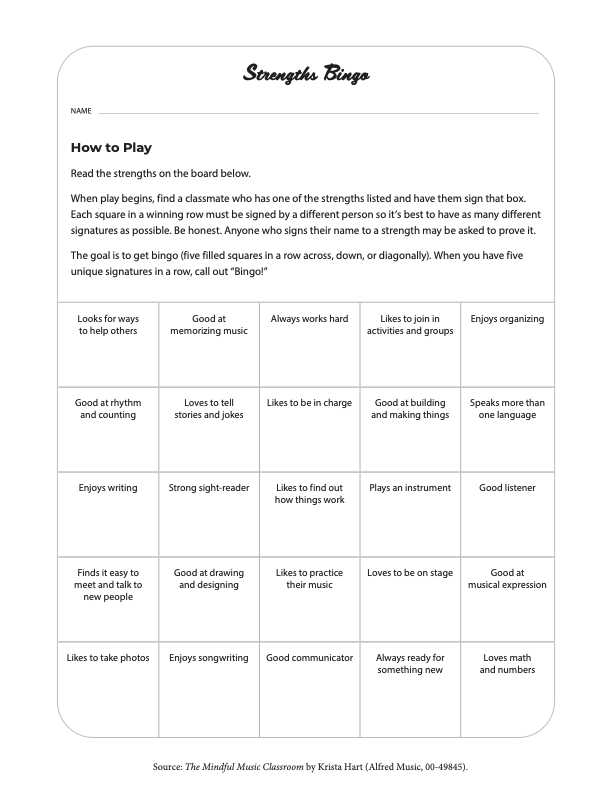
Free SEL Activity: Strengths Bingo
Get started with implementing SEL in your music classroom with this free worksheet that comes from The Mindful Music Classroom: Practical Strategies for Social-Emotional Learning .
Strengths Bingo addresses the social awareness and self-awareness SEL competencies. After completing the bingo game:
Discuss: Ask the class if it was easy or difficult to find someone to sign the squares. Did they learn anything new about their classmates? Can they give examples of how they or someone else exhibits one of the strengths? Have they thought about their own strengths before? Wrap up the discussion by noting that everyone has a different set of strengths and that this exercise includes only 25 out of an endless number of strengths that people may have.
Self-Assess: As an extension, invite students to add their initials in the boxes that list one of their strengths, and put an X across the other squares. Finally, students should draw a new row of boxes at the bottom of the card to list up to five additional strengths that they possess.