
Use This Code to Improve Your Students' Coordination
January 29, 2018|
Karl Sloman

William Shakespeare once said “timing is everything.” If that is the case, then coordination is everything, too! Coordination is the greatest skill of any musician—particularly drummers. Whether it is learning technique or patterns (physical coordination), or resolving time signatures in your head (mental coordination), coordination is critical to everything we do.
The difficulty for most musicians and instructors is how to teach and learn coordination. Many students and teachers will simply learn a series of patterns or grooves with the hope of learning various coordination strategies. At best this method of trial and error results in less than optimum results, while at worst students actually regress in their progress of developing better coordination.
So, what’s the solution?
After years of studying drumming and training (I am a military officer with immense experience in training soldiers), I have come up with a structured and complete approach to coordination studies. These studies are presented in greater detail in the book The Coordination Code , but the basic concept is outlined in the section below. This code is a systematic approach to developing 2, 3, and 4 part coordination using a notation system that rivals anything ever developed for drum set. In fact, the notation system is as important as the study of coordination itself! Using the following code will systematically take your students through the process of visually discovering how their body relates to itself and the drum set.
How the Notation Works
Using a “window” broken into four parts, the student intuitively learns what to play by aligning their body with the parts of the window as shown below.
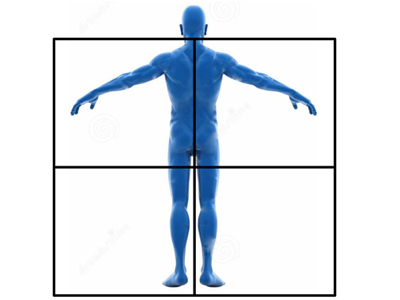
This “window” is then used as a reference point to determine which limb to use when reading the coordination notation (see below). The square that is filled-in corresponds to the “window” above.
The pattern shows the following:

- Beat 1 – Left Hand (LH) and Right Foot (RF)
- Beat 2 – LH
- Beat 3 – LH and Right Hand (RH)
- Beat 4 – LH
- Beat 5 – LH and RF
- Beat 6 – LH
- Beat 7 – LH and RH
- Beat 8 - LH
Most students—even very young ones (5 and under)—recognize the system without any explanation! I have had students performing pattern within 30 seconds of seeing the windows. Try that with standard notation!
There are a number of advantages using this system:
- It is intuitive.
- It is easy to read.
- It is easy to learn, most students in less than 5 minutes.
- It does not matter how complex the pattern, it remains simple because the student only has to sort out which boxes are filled in.
- It is standardized with no variations.
- The instructor’s job is made much easier as there is little to no explanation required.
By using the various examples and exercises in the book, combined with the notation system allows any student—regardless of experience—to improve dramatically in both their ability to negotiate complex patterns and employ advanced coordination.
Since using the system, I have found that my students reduce their time working on patterns, which reduces frustration on their part. This in turn reduces attrition and makes for a happier student. This all culminates in a happier parent.
The Coordination Code
Try The Coordination Code with your students, and let us know how it goes in the comments below! In addition to helping coordination, your students will build confidence, creativity, and strength on both sides of the body. (Each copy of the book also comes a free Skype lesson to assist instructors and students in using the system!)
Unlike many drum books, this one is not a rehashing or retelling of information already available elsewhere. Instead, this is a new system that is unique in its approach. This will set you apart as someone who uses the latest in learning technology.
