
Tips for Teaching Young String Players
October 30, 2018|
Renata Bratt

Teaching standards from traditional American fiddling literature can introduce young string players to an aspect of learning that is motivational, fun, and pedagogically appropriate. Here are several creative, alternative approaches to engage your younger students with their string instruments and setting them up for success from the start.
Learn by Singing
Children often learn to sing early in their lives. They sing tunes they’ve heard from their parents, on YouTube, on the playground, and on the radio. When we teach them to sing right away, they learn to value their own musicality. “When children feel as if they own a song, they naturally sing it with expression and personal meaning.” [Source: NAfME ]
American fiddle tunes often begin with a song. It’s much easier to memorize a tune that has words. Songs use words—and words in songs dictate the rhythm of each measure. Students will immediately play with correct rhythm if they already know the song. Songs have melody. As soon as a student can put their fingers up and down on their fingerboard, they can tell if they are going up or down in pitch. If a student can sing a song, then that student can recognize immediately whether she is playing it correctly on her instrument, even if the tune uses syncopation or requires a string change:

Everyone can sing “come out tonight” easily, even though it uses syncopation. When a student sings that melody, he can also perform it.
Fiddle tunes incorporate musical structure—often using a verse/chorus, or A/B form. Learning to sing and play music with clearly delineated musical structures helps a student understand more advanced musical structures later on.
By teaching bowed string instruments using tunes learned through singing, we can engage every part of a child’s musical brain from the very beginning.
Learn by Accompanying
In my fourth grade classroom, as soon as I teach cellists how to hold their instrument, we learn to sing “Boil Them Cabbage Down” while accompanying ourselves with open strings.
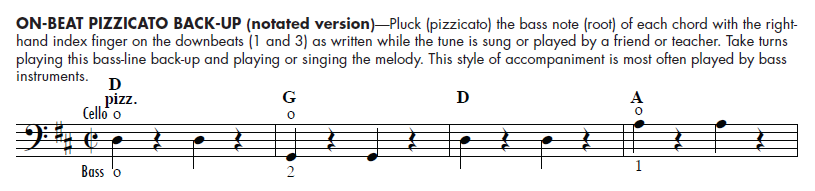
What are they learning? Students learn the names of the strings. They learn to play on-the-beat rhythms. They learn to accompany themselves while singing. They have sung a tune many times that they will soon learn to play. And perhaps most importantly, they can perform a tune for their parents or friends after the very first day of instruction.
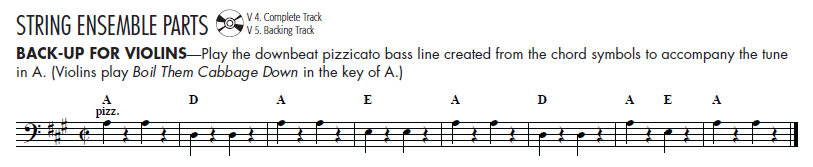
We learn to accompany the violin class too, by singing and playing back-up in their key.
Learn by Listening
We start every day by singing and accompanying “Boil Them Cabbage Down.” Sometimes, I divide the class into two sections and they take turns singing and accompanying others. Students learn to hear themselves and someone else while performing—a crucial element in ensemble playing. For the next couple of weeks we learn the D scale, the names of notes on strings (A string is ABCD, D string is DEFG, G string is GABC, C string is CDEF) and beginning repertoire from a method book.
Once the students have learned to play a D scale, I play “Boil Them Cabbage Down” on the cello for them—the first time they’ve heard it on the instrument. Students are instantly engaged and focused, because they already know this song. It has “personal meaning” to them. Often, a student will blurt out—“Whoa, this tune is just on one string!” They have learned how to listen and observe, very early in their musical process. Because they already know the song, they learn to play it very quickly, by ear as well as by observing me play. Many students come back the next day, proudly playing the tune on a different string. Because, “this tune is just on one string!” On their own, they have learned the concept of transposing.
Next I will play an advanced fiddle “break” or variation for them, often using double stops or syncopated notes. Students can accompany me using the same open string accompaniment that they’ve already learned. Again, they are learning how to play in an ensemble by listening to me play and accompanying me at the same time. These more advanced fiddle breaks help students recognize stylistic traits of fiddle tunes, just as listening to Spanish would help a student learn to speak Spanish more fluently.
Learn by Improvising
Fiddle players often improvise variations to the melody. Variations can be as easy as using a rhythm mnemonic called “taterizing” the melody. I teach the “small tater, small tater” variation a couple of days after the students have learned to play the tune. By now, I have also taught “Twinkle Variation B,” “Grandmother, Grandfather.” The only difference between these two rhythms is the accent. “Small tater” has an accent on the off-beats (tater) and “grandmother” has the accent on the on-beats (grand). Students enjoy hearing and incorporating these different accents with their bow. Right away, they are discerning an important musical element and stylistic difference between “classical” playing and fiddle playing.
After students have learned to play the tune and a variation, I teach them a “tag” for the very ending of the tune. This could be the rhythm of the ubiquitous “shave and a haircut, two bits,” or any of many other tags. I also teach them an alternate ending to the main tune—something simple that can be used as the last four measures of the tune. By the end of the school year, after learning many fiddle tunes and songs, students will have learned an entire library of variations (using open-string double stops, walking up and down from a melody, syncopated string crossings, and slurs). Students improvise effectively by stringing together their accumulated licks into cohesive phrases.

Learn by Performing
In class, I ask students to invent an arrangement of the tune. These arrangements include whether to sing or play the tune first, whether to play a variation, where and whether to include an advanced fiddle break, and who accompanies which parts. Before a concert, we also coordinate with the violinists, choosing which key to sing in, when the violinists and cellists play the tune or accompany, as well as which fiddle breaks to use. Students like to be actively involved in music making—and arranging is a huge part of that. Students enjoy singing, accompanying others, and performing tunes from memory. Playing fiddle tunes should be a component of every string program, from the beginning.
