
Tips for Teaching Jazz Piano... for Two!
April 6, 2018|
Wynn-Anne Rossi

Why Teach Jazz?
There are a host of reasons. Jazz can increase a student’s “rhythmic IQ” by transitioning from counting to feeling rhythm. It can open the musical ear to the beauty of dissonance and new harmonic possibilities. And who doesn’t love an enticing jazz melody? But most of all, jazz is just plain FUN.
Jazz music has always been known to thrive via ensembles. This makes piano duets an ideal choice. Historically, jazz has been a collaborative genre, with a primary focus on live performances ranging from small trios to expansive big bands. Jazz personifies “playing well with others.” It has a rich history of bringing diverse people together to celebrate the love of music.
Jazzin’ Americana for Two
Each piano duet in this series is enhanced with helpful trivia to awaken curiosity and broaden music education. It’s difficult to separate jazz from the humanity behind the music. Meaningful jazz stories help students connect with these famous musicians and the fascinating places where they performed. My hope is that this brief trivia will inspire further research. Consider additional student assignments, such as listening to recordings or watching YouTube videos pertaining to the jazz giants. Encourage students to collect entertaining facts that relate to a current piece.
Notice the rhythm workshops at the top of each title page. Jazz rhythms can be challenging! These “drills” will help students conquer the rhythms that drive the music. I place strong emphasis on feeling the rhythm. Teachers may want to begin with traditional counting; however, jazz is a listening art, and the ear takes precedence. Lap-tap the rhythms with the students until muscle memory kicks in. Sometimes my students and I will lap-tap an entire piece together! Right vs. left “taps” replace the notes. This was a helpful technique I learned from one of my early piano instructors.
Though improvisation is a key element in jazz, these books are designed as an introduction into the sounds of jazz . Each piece focuses on a distinct style, ranging from ragtime to modern jazz. If students are excited to take that extra step into experimentation, they are welcome to extract certain chord patterns to explore. An example is in the opening two measures of “Pioneer Rag.” While the secondo sets up a repetitive “riff”, the primo can explore any notes in the key of C with an emphasis on rag-like syncopations. Duet improvisations are great fun. The popular “Heart & Soul,” which most American students know and love, is living proof!
What about group lessons and Summer camps? Jazz can be a fantastic focus for group education. Experience the jazz journey by gathering interesting facts, practicing rhythm workshops together and sharing live performances in a wide variety of styles. Duets can set the stage. Creative percussion, based on the rhythm workshops, will involve everyone!
Let’s take a look at an example from book one.
Welcome to the Savoy
This duet celebrates a legendary jazz venue (see preview below). The opening trivia states:
“The Savoy Ballroom opened its doors on March 12, 1926 in the heart of Harlem, New York City. It was the home of famous big band competitions, and all people were welcome ... as long as you could dance!”
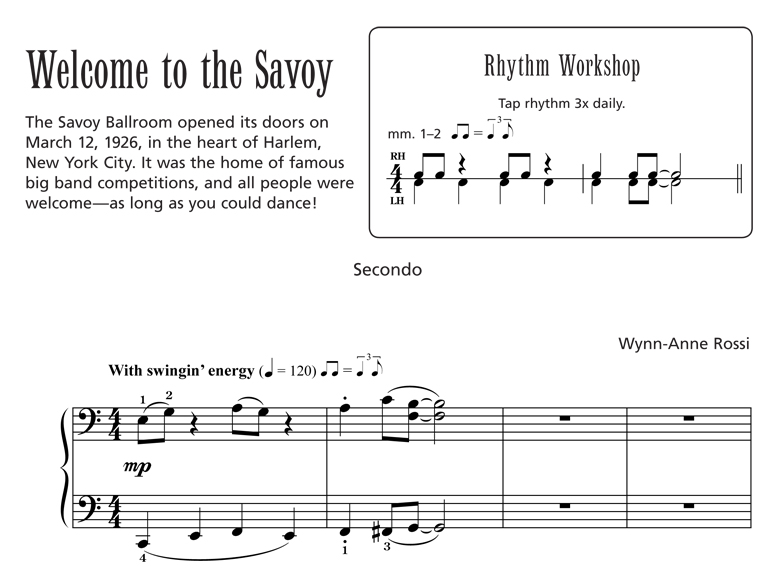
This composition is in the big band style, so it swings . Be sure to spend quality time with the rhythm workshops at the top of the page. I keep a large drum in the studio, in lieu of lap-tapping, so my students always love this playful preparation. We often take turns between listening and drumming for each other.
In the opening eight measures of this piece, it is immediately obvious that the two pianists are “dueling” for the melody. This call and response technique mimics the band competitions that were a Savoy tradition. This piece is all about playful communication between the parts. Instead of competing bands, the music expresses back and forth banter between duet partners!
At measure #9, the secondo usurps the melody while the primo engages in supportive harmony. Jazz often has a sense of humor, so notice the musical markings! Careful articulations will promote elements of surprise and emphasize syncopations.
The secondo part in Measure #17 takes us back to the opening melody, while primo awakens the ear with spicy harmonies. There is a swift dynamic change at measure #23, primo. This quiet moment sets up a big crescendo, landing in the final fortissimo!
Heartbreaker
In book two, you will find a deeply emotional jazz ballad called “Heartbreaker,” in honor of Chet Baker. Sometimes referred to as the “James Dean of music,” this complex human being offered poignant lessons for all of us. The trivia states:
“Trumpeter Chesney Henry “Chet” Baker (1929-1988) lived a complicated life. After a street fight, he lost his front teeth and the ability to play his instrument. However, he conquered the challenge and eventually thrived in the cool jazz genre.”
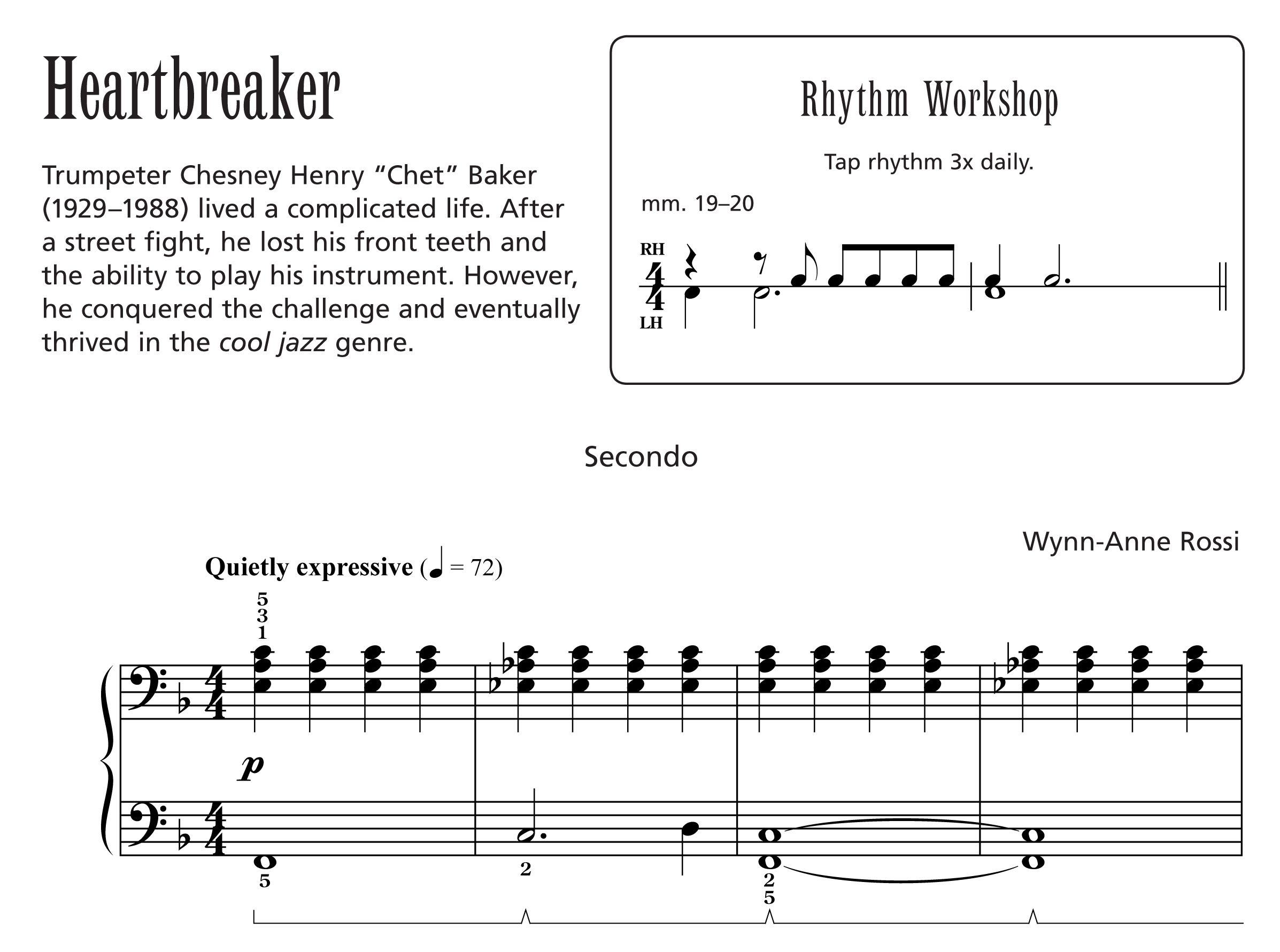
Melody is the primary focus of this piece, beginning in primo, measure #5. I originally wrote lyrics, capturing the pain of heartbreak and separation. Playing with text helped me land on sounds that no longer needed words. Students may wish to experiment by composing their own private lyrics. The primo part appears easy, but performing a melodic line is harder than it looks. This is an ideal opportunity to teach the significance of melodic shaping.
Slow chord changes on the quarter note throughout the piece are reminiscent of Chopin’s melancholy Prelude in E minor, opus 28, #4 . The harmony in measure #1 begins with F major 7th chords alternating with Ab major, setting the scene for the haunting melodic entrance. Note that Ab major easily transforms to the darker F minor 7th, thanks to three common tones. See measure #4, secondo. Accidentals have been notated for ease of reading. Thus, sharped 9ths are written enharmonically. See measure #8, secondo.
The composition has a simple A - A form, ending with a dissonant 11th chord. This heartbreak doesn’t appear to resolve with a happy ending. All emotions are open for discovery as we travel this lifelong, musical journey together.
Big band swing and an emotional jazz ballad are just the beginning. This new duet series includes a wide array of jazz styles. Other pieces include “Crazy Chops”, “Royal Blue for Mary Lou”, “Buddy Boobop” and many more. Students will get to know the names of jazz giants like Herbie Hancock and McCoy Tyner.
Jazz is an ever-evolving human expression that has swept through America and now reaches around the world.
Cheers to a jazzy future!
