
Rehearsal Hacks: 7 Tools to Improve Rhythm Skills
April 4, 2018|
Katie O'Connor-Ballantyne

In my last article, 7 Tools Your Students Need in Their Music Fundamentals Toolbox, I talked a little about the tools that every freshman music major should have at their disposal when arriving on campus.
“Sure,” you say. “That’s nice. I’ve got a program to run, however. There are concerts to prepare for, and solo festival, and a Tri-M chapter to advise. I can’t fit anything else in!”
I’m a big believer in small, intentional, incremental changes in service of a larger goal. You don’t need to reinvent your entire program with literacy as the primary focus. Start with changing up one or two things in your rehearsals, and as you feel comfortable, add more.
Here are a few of my favorite music literacy “rehearsal hacks,” taken from my own classrooms and rehearsals. For your convenience, I’ve aligned them to the toolbox topics. Today, we focus exclusively on the concept of rhythm, and on developing reading and listening skills related to rhythmic notation.
1. The Rhythm Grid
Rhythm reading is primarily a process of pattern recognition. I first learned this rhythm drill method from Dr. John W. White at Ithaca College, and have continued to adapt it for use with virtually every class I’ve taught ever since.
Take basic 1-beat patterns of any beat size (for example, beat = quarter note, half note, or eighth note) and arrange them randomly in a 4 x 8 grid (click the preview image below to view the entire sample ). Using whatever rhythm pedagogy you have in your curriculum (I am partial to Takadimi, personally), teach your students to count them aloud.
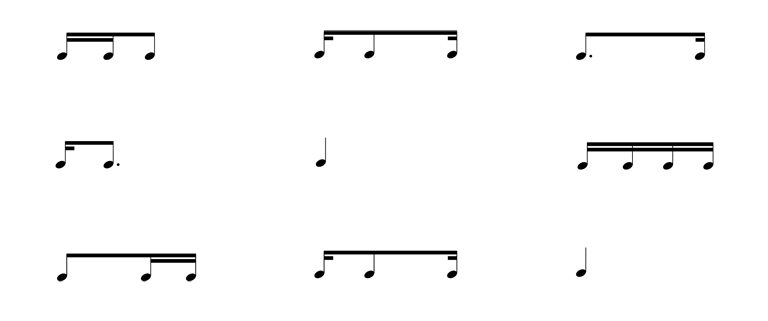
Begin by repeating each pattern four times (like you would for a measure 4 beats long) before moving to the next one in the grid. Once the group has mastered reading all patterns in 4 beats in one direction, change it up: read the grid again from left to right, or top to bottom, or in serpentine fashion. Once that’s comfortable, repeat each pattern only twice before moving on. Finally, move to just one beat per pattern – now that pattern recognition allows students to decode notation at a much more rapid rate.
One or two passes through the grid per rehearsal will yield incredible results in a matter of weeks. To extend the activity further, “translate” the grid to other beat sizes: make the half note get the beat, or the eighth note. The same idea can be used for compound meters (beat = dotted quarter note, dotted eighth note, or dotted half note). Your musicians will never be flummoxed by 6/8 again!
2. Pattern Reading and Scale Practice
Don’t be content to practice your warmup scales the same way every day! Put a simple 1-2 measure pattern on the board, or use a pre-printed resource like these flash cards , and sing or play your warmup scales using the rhythm on each scale degree. For added interest, give two different patterns, and use one while ascending, and the other while descending.
3. Rhythm Fill-in-the-Blank
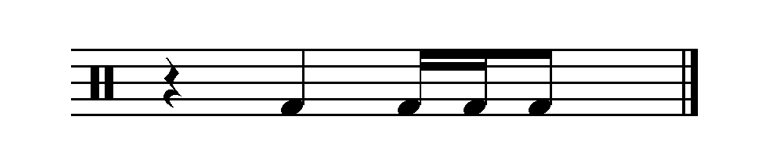
If you use “bell work,” or other transitional activities, try this: write an incomplete measure of rhythm on the board, making sure you include the meter. Ask students to write a rhythm (note or rest) to correctly complete the measure. You can start by offering multiple choice answers, or limiting options to a single note or rest (for example, writing a measure of 4/4 with three and a half beats in it, and asking for a single note or rest to fill the missing space). As students get more confident, you can ask them to fill in any pattern of notes or rests that adequately finish the measure. Then, perform a few of them, or use them for the scale warmup exercise above.
Example :

Possible answers could include:
4. Insert the Bar Lines
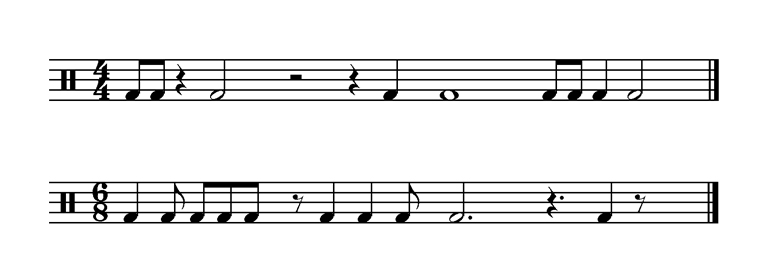
Take a multi-measure excerpt of music, provide the meter signature, and remove the bar lines. Ask students to put them in the correct place. You can also have them write in the counting for whatever rhythm pedagogy you use.
5. Find That Pattern!
Another “bell work” suggestion: put three brief rhythm examples up on the board (1-4 measures, depending on the comfort level of your group). Play, sing, or clap one of them and ask students to identify which one you performed.
6. Correct My Mistake
This exercise is a further extension of the aural discrimination and visual decoding skills you develop in Find That Pattern. Play or sing a phrase from piece of music your ensemble is currently working on, but insert a rhythmic mistake: for example, change a dotted rhythm to one without dots, insert an extra beat to mimic a breath that takes too long, or clip a long note short. Ask them to tell you where the mistake happened and what it was. The sooner students can discover and detect their own mistakes, the sooner they take ownership of the music!
7. Rhythm Bingo
Once you’ve built those rhythm reading skills up, you’re ready for a fun day or an easy sub plan using Rhythm Bingo , which also corresponds with Alfred’s Essentials of Music Theory book series. Students listen and locate rhythms on their score card to win. To simplify the activity, you could have the entire class identify a pattern before having them search their cards. To make it harder, insist that they do the decoding and identification themselves.
Note that if you regularly use any of these activities in your rehearsals, they can be easily turned into assessments: you could have students record themselves performing the Rhythm Grid, or play or sing a scale on a provided rhythm pattern at sight. Any of the examples involving written work (such as Correct My Mistake, Find that Pattern, or Insert the Barlines) could be adapted for use in a written test. You could even use the same examples at the beginning and end of the year for a formative and summative assessments.
Time spent on enhancing the aural skills of your students is never wasted! Better music literacy speeds the pace of your rehearsals, improves the overall confidence of your ensemble, and gives your students a more active role in their own learning. Get started today!
What are your favorite ways to work on rhythm literacy? Tell us in the comments below!
