
Piano Author Q&A: Spotlight on Elizabeth Swift
November 12, 2024|
Elizabeth Swift

Elizabeth Swift is a composer and piano teacher based in greater Cincinnati, Ohio. While rooted in classical training, Elizabeth integrates a variety of musical styles in her compositions, fostering a rich and eclectic musical experience for a diverse range of students. Drawing inspiration from her adventures in travel and the outdoors, Elizabeth infuses her teaching and composing with a sense of adventure and exploration. Her premiere piece with Alfred Music, Saga Land , captures musical adventure inspired by the captivating style of video games.
Keep reading to find out more about composer Elizabeth Swift and the inspiration behind her piano book, Saga Land .
What do you remember about your early years of piano lessons? Do you remember your first lesson?
Apparently, I had been asking for piano lessons for some time, and my parents gave in when I was around 7 years old. My older brother and sister also studied piano, but they had a different teacher…a gentle older woman who taught in a very traditional way and assumed students would simply do what they were told and also practice their repertoire. I feel like there was some mention of that teacher being unable to “handle me,” so I was sent elsewhere. Ironically both teachers had the same last name, no relation. So my Mrs. Miller was a quirky and wonderful woman who encouraged me greatly. I didn’t practice all that much while I was with her and sight-read many of my lessons, but I enjoyed my lessons and knew I would continue when we moved to another state.
I was lucky to have studied with several wonderful teachers after that, one of whom was Diane Mitchell in Downingtown, Pennsylvania. I studied with her in junior high in the 80s. That’s right, I was in junior high school in the 80s. I got to be 13 and follow trends set by Cyndi Lauper at the same time. I know you’re wishing you were me right now! Anyway, Mrs. Mitchell was so cool that even though we were working on a Mozart Fantasy in lessons, several other students and I would come to her house in the evenings and play keyboards on her dining room table. It felt so foreign to me to play along to an electronic drumbeat, poke around on the keyboard until I figured out “Axel F,” and then jam out on the chords, but that was my first experience playing something that wasn’t written out.
What inspired you to start composing?
Many composers who are also teachers seem to start composing for their students, and then things take off from there. Well, I have composed for my students for years, but I was never interested in sharing what I came up with. It felt very utilitarian and specific to those students and their needs. But years after I had started composing for my students I volunteered to play piano on my church’s worship team, which is actually when I figured out how to compose on the fly. So I would sit at the piano and let ideas flow without editing or judging them. Improvising had become cathartic, and that was when I was inspired to share what I was coming up with. My creations felt more organic and meaningful. And that really is my compositional style.
Do you play / Have you played video games? Do your kids? If so, which kinds of games are your favorite?
I have four children. Three of them are boys, and they went through a phase of playing lots of video games. Naturally I heard a lot of this gaming, and there were even certain games that I also liked and played with them, though only on the Wii! In particular, it was part of our daily routine to have a Mario Kart battle after lunch when my now 19-year-old son, Aaron, was in kindergarten.
I was so impressed with the quality of the music, but more importantly, its ability to capture or change the feel of the different levels and to transport the player into a unique world with each song. I wanted to create this experience for piano students in general and also maybe to help out the students who might be obsessed with video games and their incredible music but may not be ready to play the more difficult music of games like Zelda , Mario , or Final Fantasy . The difficulty of these pieces is just one hurdle. The other is that the selections are not pianistic.
How would you like to see teachers using Saga Land with their students?
The beauty of the book is that you can do as little or as much with it as you like.
- Open it and play (sounds great on digital instruments)
- Use it as a fun and motivating addition to weekly lessons and practice
- Prepare a studio recital using Saga Land as the focus. You can intersperse the Saga Land selections with other fantasy or video game selections.
- Create a studio project where students learn the various pieces in Saga Land , come up with a storyline or plot for their selection, and present it before they perform. You could also have students create their own background videos for their pieces. (A wonderful teacher named Dana Martin purchased my older, unimproved version of Saga Land and created a whole virtual recital doing just this. Students made videos, narrated a storyline for their selection, and performed their pieces in the background. It was so amazingly cool and just what I had hoped for!
- Many of the pieces also offer so much opportunity for chord analysis, so it’s a natural outcome to alter those chords. Students can completely change the feel of the composition by switching the A minor chords in “Fortress in the Clouds” to A Major. And it can be a motivating and educational activity to decide on a new action or title with the new chords.
What did you find most challenging about writing this collection?
I worked really hard to keep the pieces accessible to early to mid-intermediate pianists and also make them interesting to both players and listeners. It is also a delicate balance to write music that is patterned but not predictable, so I spent a great deal of time filling these pieces with harmonic twists and turns that felt organic yet surprising. And finally, I was challenged to come up with titles and sound pictures that would inspire students to be drawn into the story of Saga Land .
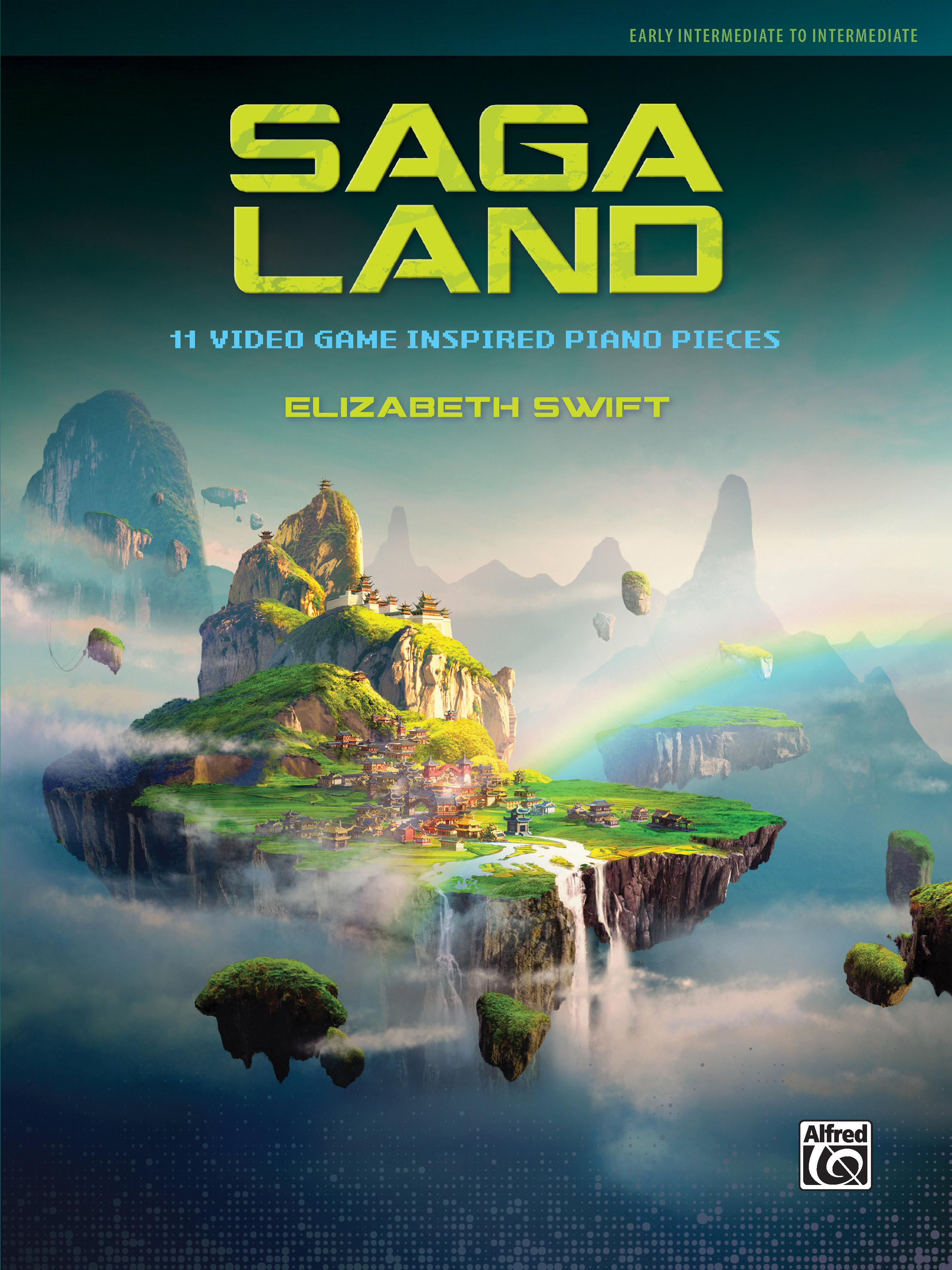
Saga Land by Elizabeth Swift is a musical adventure inspired by the captivating style of video games. Designed with students in mind, these epic works are easier than typical game music, fitting well in the hands. They invite players to explore an imaginary world filled with epic stories, characters, and places. Each composition is crafted to spark the imagination and encourage pianists to create their own narrative as they play.
