
Piano Author Q&A: Spotlight on Angela Marshall
November 12, 2024|
Angela Marshall

Angela Marshall’s career spans composition, authorship, and education, making her a multifaceted force in the music world. With a diverse portfolio that includes educational piano solos, instructional books, and novels under the name A.G. Marshall, Angela brings a unique perspective to her work. Her teaching journey covers a broad range of settings—from private studios to universities—where she’s taught piano, composition, and voice. Her acclaimed Alfred composition Romanza won the Lynn Freeman Olson Award and was featured in the 2016-2020 NFMC Bulletin. We recently sat down with Angela to dive deeper into her inspirations, creative journey, and newest publication with Alfred, Take the Stage!
How did you get your start in music?
I come from a very musical family. In fact, we’ve only recently learned how far back our musical heritage goes. A few years ago, a relative from Norway sent us a handwritten genealogy and one entry reads: “Ella, born 1893, concert pianist.” Both my parents are musicians, and my grandparents were musicians as well. So I grew up surrounded by music and absolutely loved it.
My love of piano, in particular, came from my Grandma Jan, who was a church pianist. She read music a little but mostly played by ear and improvised. She also wrote praise songs for her church. I sat on her lap as a baby and listened to her play and sing. As I got older, I played along with her. We lived within walking distance of her house, and often we could hear piano music pouring out her window while we were still walking down the sidewalk. Because of her, piano was the instrument I wanted to play most as a child. I play several instruments now and love all kinds of music, but the piano is my heart.
What do you remember about your early years of piano lessons? Do you remember your first lesson?
When I was very young, we couldn’t afford lessons, and I grew up in a small town where the few piano teachers available had long waiting lists. So, at first, I taught myself to read music from my Grandma Jan’s copy of the Leila Fletcher Piano Course, and she showed me how to play scales and chords.
I remember my first formal lesson with a teacher vividly. I was ten years old and so nervous that I wouldn’t be good enough that I almost didn’t make it through the door. Her house was lit only by a lamp on the piano, so it was a bit shadowy and mysterious. She sat on a carved wooden chair that looked like a throne, and her grand piano was completely covered with doilies and knick-knacks. I remember thinking it was a waste to have a grand piano if you couldn’t open it, and now that I have my own grand, I don’t put anything on it but the occasional music book. I don’t remember what we worked on that lesson, but I have never forgotten how intimidated I was to start formal music study.
I played ahead in the lesson book every week since I read music better than she knew I could, but she caught on quickly and started asking how far ahead I had practiced. She was also a stickler for good technique. My best friend Audrey had been taking lessons for several years by the time I started and was already quite good, so I worked very hard to catch up to her. I don’t know that I’ve ever felt that level of motivation to practice again, even when working on degrees and giving recitals. Audrey and I are still friends and continue to meet up and make music as adults.
What inspired you to start composing?
I composed songs at the piano before I could read music or knew any theory. I would just play keys until I found sounds that I liked, and that became an expressive outlet that I absolutely loved. None of my music teachers had a background in composition, and my formal lessons were focused on classical repertoire and technique. I loved studying those subjects, but I also loved composing and kept doing that on my own. I wrote silly songs for videos I made with my siblings and sometimes shared my compositions with friends and family, but that was as far as it went at the time.
I didn’t formally study composition until college. I was lucky to attend East Central University, where established Alfred composer W. T. Skye Garcia taught. He became, and still is, my composition mentor. He’s an amazing composition teacher and has such a specialized knowledge of pedagogical piano composition that working with him was a perfect fit. I think I would have composed in one form or another whatever I studied, but I wouldn’t be professionally writing music for young pianists without his guidance. He helped me edit my piece Romanza and submit it to Alfred for publication, so he’s also been a big part of my publishing journey and my professional relationship with Alfred. As a fun side note, I wrote Romanza as a wedding gift for Audrey, the friend I was catching up to in my early years of piano lessons.
What do you remember about recitals growing up? Do your experiences influence the way you conduct your own recitals now?
I still remember my very first recital piece! It was Sugar Cookies by David Carr Glover, and I worked so hard to get a good contrast between the legato and staccato sections in my performance. I had very traditional recitals growing up. Students dressed in their best clothes and performed one after the other at a local church. I remember being nervous, choosing my outfit very carefully so that my arms wouldn’t be restricted, and being excited to perform on a stage with a nice piano. If I’m being completely honest, I also remember being a little bored at how similar the format was every time. I did theater from elementary school to college, and the contrast of costume changes, lights, and sets compared to the sameness of the traditional piano recital format started to bother me. I wanted piano performances to feel as dynamic as my theater shows, which led me to experiment with my own performances and student recitals.
That’s taken very different forms over the years. When I had a large, in-person studio, I collaborated with Davis Dorrough on very elaborate recitals. We had a movie-themed recital where everyone dressed up in character to match their piece. I played the theme from Jurassic Park and wore one of those inflatable T-rex costumes. We also had an outdoor recital at a local park, a recital with pre-recorded video interviews for each student that played before their performance, and had students play gigs at a local coffee shop. I even merged my theater, writing, and piano backgrounds in a musical murder mystery play called Under a Rest, which was written as a collaboration with Dr. Olivia Ellis for her piano ensemble to perform.
These days I have a small online studio of eight students, so recitals take yet another form. We meet at my house, play for each other, and decorate sugar cookies. Since lessons happen online, I want recitals to be a time of community building as well as performance. At one Christmas recital a few years ago, only one student could make it because everyone else was sick or out of town. I was worried that she wouldn’t have a good experience with only me and her parents as an audience, but she still talks about that recital as her favorite one. I’ve had other students tell me that they prefer the traditional recital format over the elaborate productions. So I don’t think there’s any one right way to do recitals, and I love using my experiences and feedback from students and parents to create unique experiences.
How would you like to see teachers using Take the Stage! with their students?
Most of all, I want them to have fun! I would love to see teachers and students make the music and performances their own with their creative ideas. I wrote these pieces to motivate beginners and give them a chance to shine, which will look different for every student!
I have also used these as backup recital pieces for late-elementary or early-intermediate students who picked an ambitious recital piece and didn’t quite get it ready in time. These can be learned quickly and turned into a very interesting performance, so it isn’t obvious that the student is playing a Plan B piece. They’re a great way to give students an easy win, on and off the stage.
This collection includes performance notes with ways to make performances more exciting or adapt the music to different situations, but there simply wasn’t room to include every idea. I officially want to give everyone permission to adapt the music and performance ideas in this book to meet their unique needs. I want beginning students to be the stars of the show!
What did you find most challenging about writing this collection?
Keeping the music easy! I wanted every piece to be truly suitable for beginners, which meant editing and editing until everything was just right. Some pieces started in my head as sweeping symphonic scores, and I had to simplify them down to a single-note melody with a teacher duet part. I was essentially creating an arrangement of my own work to keep the level accessible! Davis Dorough was such a great editor for this project. We had several Zoom calls to discuss technical challenges and how to keep the music sounding great while also keeping it easy enough for students at the very start of their piano journey.
Do you have any advice for young composers or teachers who are mentoring them?
Start writing and keep writing! Composition, like playing an instrument, is a skill that improves with practice. The best way to get better at it is to do it. So start, finish, and edit some music. You’ll learn something different from each stage of each piece you compose. I spent a lot of time doubting myself as a young composer, and even now, doubts creep in when I start a new project. But the best way to fight those doubts is to spend time composing music. That goes for young composers as well as teachers who would like to compose. It is never too late to learn to compose or start including composition in your lesson plans.
Listening to music is also a very valuable tool for a composer. Listen to music for fun, and when you find something you really love, take it apart and see how they did it. Of course, to take the music apart, you’ll need to know some theory. Music theory is a composer’s secret weapon!
I absolutely love teaching composition to my students, and I would love to see composition included in more lessons. It’s a great way to combine multiple musical skills while giving students a lifelong tool for self-expression.
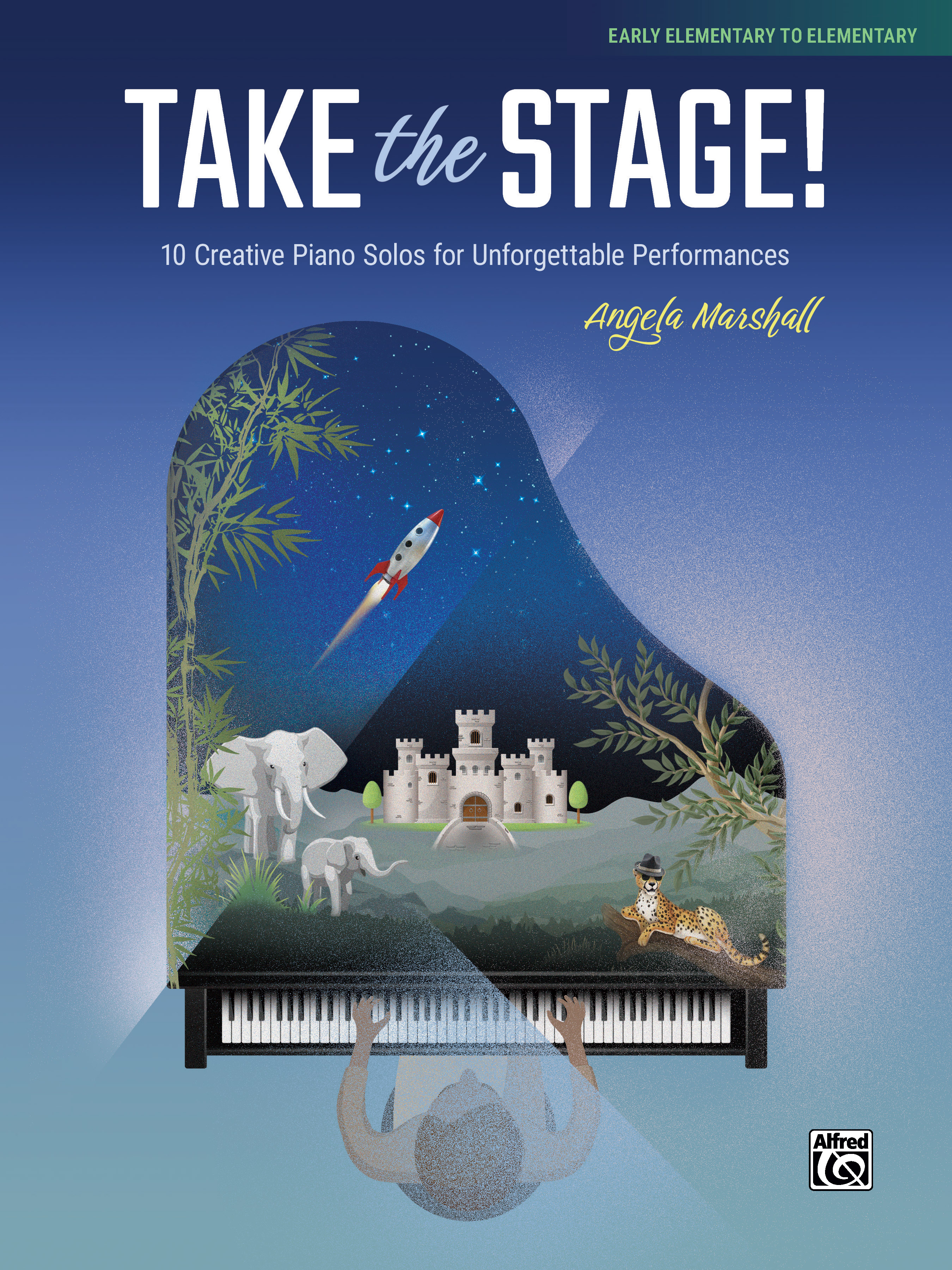
Take the Stage! by Angela Marshall allows beginning students to create show-stopping performances. Pieces incorporate fun hand acrobatics, pedal effects, props, improvisation, and audience participation to elevate first recitals into truly special moments. Leave students feeling accomplished and audiences wowed with this motivating and accessible collection.
