
A Multicultural Approach to Teaching Improvisation
August 31, 2023|
Cooper Ford

Improvisation has many potential benefits for our instrumental students. Not only does it foster creativity, but it also deepens musical thinking and understanding. While music educators may desire to teach improvisation, many may find it daunting, whether due to concert pressure or the lack of personal knowledge, skill, and/or experience. Additionally, there is the perception that improvisation is limited to the realm of jazz and can often seem beyond understanding with its complexities. The reality is that many musical traditions utilize various aspects of improvisation and can give us the tools to make improvisation accessible to our students, providing a gateway to a new realm of musical experiences.
Before delving in, it’s important to remember that learning to improvise is like learning to speak a language. We all improvise in conversation regularly, utilizing a vocabulary and syntax with common meaning to listen and respond with understanding. When children learn a language, they often listen, repeating words and phrases. It’s simple at first, but with time, their expertise grows. In music, we can begin simply with call-and-response exercises. Many of us are familiar with the one where we clap or play a rhythm and students echo it, but what would happen if we changed it up and had them respond with something that must be different? Or how about the first half of the response must echo and the second part must differ? Suddenly, we are having a musical conversation! A quick online search (or conversation with one of your elementary general music colleagues) will reveal a plethora of potential activities which can easily be integrated into an ensemble warmup and provide simple first steps in improvisation.
In addition to these exercises, there are various musical traditions that focus on certain musical concepts that can create an accessible gateway into improvisation. For example, in Turkish and Arabic classical music, taqsim is a musical form that does not use a prescribed rhythm and focuses on pitch. With a drone in the background, musicians take turns creating a musical phrase with a certain set of notes. (The example below comes from Sound Innovations for String Orchestra: Creative Warmups , which includes several examples, along with demonstration videos and musical tracks).
South Indian Classical (Carnatic) Music utilizes a similar approach. Musical creations are based upon raagas, a system of scales based on 72 possible combinations of notes (see below). Many pieces will begin with an improvisation over a drone that utilizes these notes. As an activity, students can use a prescribed raga or create their own and then improvise musical ideas.
(Chart from https://en.wikipedia.org/wiki/Raga )
A final example is the chaconne, a musical form popular in the Baroque period of the Western European tradition. Essentially, the created melody is based on a repeating harmonic progression, so while pitch and meter are limited, there is greater freedom of rhythm. In addition to the Western European classical tradition, this approach can be used in a variety of musical styles, such as blues, pop, and rock. (Once again, see below from Sound Innovations for String Orchestra: Creative Warmups . )
Another approach to improvisation is learning a basic melody and then using it as the foundation for embellishment with varied pitch and rhythm, as well as ornamentations. Celtic Fiddling is one style where this is common. For example, Skye Boat Song is a Scottish song that is well known by many Celtic fiddlers, but each will add different ornamentations to make it their own. (For example, see Hanneke Cassel’s rendition here .) Students can learn these same melodies along with various embellishments to create their own renditions of these melodies. (A fantastic resource is Basic Fiddlers Philharmonic: Celtic Fiddle Tunes .) Ornamentations are also an essential part of Carnatic music. As an extension of the previous activity, students can learn ornamentations of this style and integrate them into their improvisations.
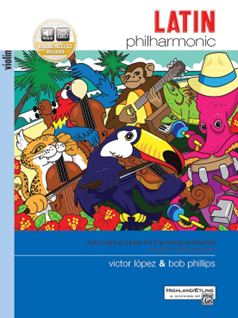
To take it a step further (and perhaps a step closer to what is often thought of in jazz), certain Latin music styles will feature an approach that begins and ends with an established tune with an improvised solo in the middle based on the same chord progression. Similar to Celtic fiddling, students can learn the foundation of the melody and then develop appropriate varied musical phrases to create their own improvisations. As added bonuses, resources such as Latin Philharmonic , are often concert-ready, allowing students to easily take the next step of performing their improvisations with their orchestra before a live audience.
These are just a small sample of the numerous possibilities. While it can be tempting to try to do everything, as a suggestion, choose one or two and take it from there. These are the first steps of a much longer journey that is well worth it. Through this, you will help students broaden their horizons by experiencing the musical traditions of a greater diversity of cultures, and derive the benefits of learning improvisation. Amazing things can happen!
