
How to Strategically Introduce a New Piece to Your Piano Student
February 27, 2018|
Elvina Pearce

Starting a new piece is a special event for students, so getting them off to a good start is very important! When introducing a new piece, I use a “Four-Point Plan” to help students explore, listen, analyze, and practice properly. Consider taking the four steps before sending the student off to practice.
1) Explore: What is the piece about?
I ask the student a series of questions to aid with learning. I explore these questions together with the student in the lesson. Using "Toccata Breve" from Elvina Pearce's Favorite Solos, Book 2 as an example, questions for this piece might include:
• What is a toccata? • What does breve mean? • Above measure one, what words are used to suggest the piece’s character? • How will the dynamics and other things such as the tempo, rhythm, staccatos, and accents affect the interpretation and mood of this piece?
2) Listen: What does the piece sound like?
After discussing what the piece is about, I play it for the student before determining how to practice it. I play it because I think it is unrealistic to expect students to be enthusiastic about learning to play a new piece without having actually heard it. However, I do make an exception to this policy with elementary-level students who are in the process of acquiring reading skills, because I want to be sure that they are actually reading their pieces and not just playing by ear.
3) Analyze: What are the piece's form and structural elements?
Because I always ask my students to follow the music as they listen to the performance, they are ready to analyze its structure, dividing it into sections and labeling them. Example 1 illustrates how a student might mark and label the form of “Toccata Breve.”
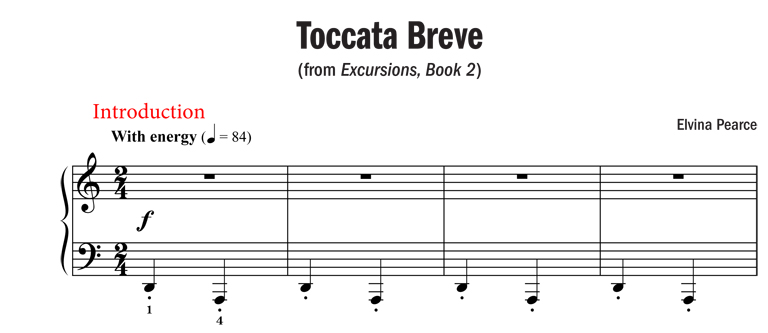
(Click the image to view the full PDF sample from Elvina Pearce's Favorite Solos, Book 2 .)
In addition to its formal structure, I discuss with the student other useful information that a formal analysis reveals about this piece. Some examples follow:
- Except for the last line, the LH part consists of only two intervals. What are the two intervals? (4ths and 5ths) Which two fingers play the 4ths? (1 and 4) Which two fingers play the 5ths? (5 and 1)
- The RH also consists mostly of just two intervals. What are the two intervals? (3rds and 4ths) Which two fingers play the 3rds? (1 and 3) Which two fingers play the 4ths?(1 and 4 as in m. 6, or 2 and 5 as in m. 11).
- How many times does the RH play three-note blocked chords? (Seven) All but one of these are 6/3 (1st inversion) chords. In which measure is there a different chord? (m. 16) What kind of a chord is in this measure? (A 5/3 root position minor triad).
- Dynamically, how is the B section different from the A section? (The B section is mf, softer than the first A section which is f.)
- In which measures does the tempo slow down? (m. 20, and mm. 31-32)
4) Practice: How should the piece be practiced?
The successful outcome of a piece depends on practice—not on how much, but on how it is practiced. Besides understanding the form of a piece before beginning to work on it, a thorough analysis of its structural elements also provides valuable clues about how to practice it.
I categorize practice procedures such as those that follow as the “mechanics” of practicing. These are the things that need to be done to be able to play pieces accurately at the appropriate tempo with technical ease and security.
Practice Tips for Working Out “Toccata Breve”
Recommended tips for how to practice “Toccata Breve” follow. When students try these practice steps, they are able to learn this piece quickly!
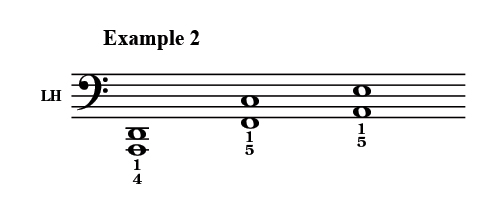
LH : Play the two notes of each interval from the left hand part blocked together as shown in Example 2. Practicing the LH part in this way means that students are becoming comfortable with the hand position shifts.
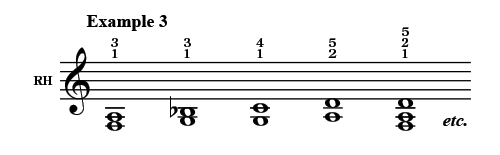
RH : Play the intervals only (not in rhythm) moving from one interval to the next until these changes can be easily executed as in Example 3. When this can be done easily, play the RH as written, adding the rhythm, and counting aloud.
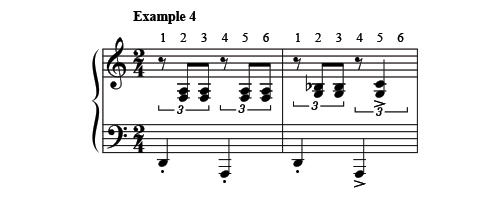
When playing “Toccata Breve” at a slow tempo, I recommend that it be counted as if written in 6/8 time rather than 2/4 because of the triplets. See Example 4 below. Notice that the accented quarter note occurs on count 5.
Hands Together (HT) : When practicing hands together, work in short sections (A, B, Coda). First, play each section HT with LH as written and RH blocked as shown in Example 5.
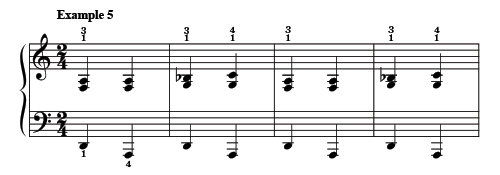
Next, play HT as written at a “thinking tempo.” A “thinking tempo” is the speed at which a piece can be played 100% accurately with technical security. This is usually very slow in the workout phase of a new piece, and in the case of “Toccata Breve,” a “thinking tempo” might be eighth note = 96. When secure at eighth note = 96, once again working in sections, increase the tempo incrementally until arriving at the suggested performance tempo (quarter note = 84).
Once a piece can be played securely at the desired performance tempo, then the focus in practice can shift from mechanics to musicality. In “Toccata Breve,” this would entail adding the dynamics, the ritardandos, the pedal in measure 20, and above all, striving to create a very lively and energetic character throughout.
When the approach is based on the "Four-Point Plan," learning the piece will get off to a good start. Students should have access to and then carefully follow specific practice steps that are designed to make it possible to achieve maximum success with a minimum amount of time and effort. The overall goal is always to get to the “good stuff”—the musicality of a piece—as soon as possible so that the player can experience the enjoyment and satisfaction of creating a rewarding musical performance!
The pieces in the three books of Elvina Pearce’s Favorite Solos series were designed as recreational music that can be learned quickly and played for enjoyment. “Toccata Breve” is one of my favorite pieces from Book 2 and I hope that you will enjoy playing it and the other pieces in the series as much as I enjoyed writing them!
