
Getting Started with Social-Emotional Learning in the Music Room
August 11, 2022|
Krista Hart

Has social-emotional learning (SEL) made its way into your school yet? Maybe it’s been a topic of an in-service or an initiative from your principal? Social-emotional learning is more than just an educational buzzword, it has tremendous benefits for students now and in the future. And, music teachers are uniquely positioned to incorporate SEL into their curriculum in a natural and subtle way.
What is social-emotional learning?
Social-emotional learning (SEL) refers to the process of developing and exhibiting the skills, behaviors, and attitudes that lead to healthy identities, emotional management, supportive relationships, and responsible decisions. These are skills that are hard to quantify but must be learned in order to successfully navigate school, work, and life. People with strong social-emotional skills can more easily cope with challenges, manage emotions, and achieve goals. Incorporating SEL into your teaching means you create opportunities for students to rehearse and apply skills related to these competencies.
SEL is not the practices themselves—the connected practices collectively build and contribute to SEL skills. SEL is ideally interwoven into classroom practices such that it would be hard to tell SEL activities apart from other routines. Ideally, students should be given multiple opportunities throughout their day to practice these competencies.
These are the five competencies that make up social-emotional learning:
Self-Awareness : the ability to recognize your own emotions, thoughts, and values and how they influence your behavior in different situations.
Self-Management : the ability to effectively manage your emotions, thoughts, and behaviors to achieve your personal and collective goals.
Social Awareness : the ability to understand the perspectives of and empathize with others, including those from diverse backgrounds and cultures, and to understand broader historical and social norms for behavior.
Relationship Skills : the ability to establish and maintain healthy relationships and to effectively navigate settings with diverse individuals and groups.
Responsible Decision-Making : the ability to make positive and constructive choices about your behavior and social interactions across diverse situations, and to evaluate the consequences of your actions for personal and collective well-being.
Don’t we already do this in music class?
In many ways, yes! It may not have been labeled as an SEL strategy, but many aspects of the competencies are naturally embedded in music classrooms. We often ask students to identify emotions in music (self-awareness), to work collaboratively in a group (social awareness, relationship skills), and to exhibit the discipline to practice (self-management). Music educators have the added benefit of being able to build authentic relationships with students, as you see the same students over the course of multiple years.
Make a conscious effort for SEL to become a normal part of what you do in the classroom. Work to identify those aspects of your curriculum and culture that already fall under SEL, and establish a deliberate and consistent practice of incorporating SEL activities into your classes.
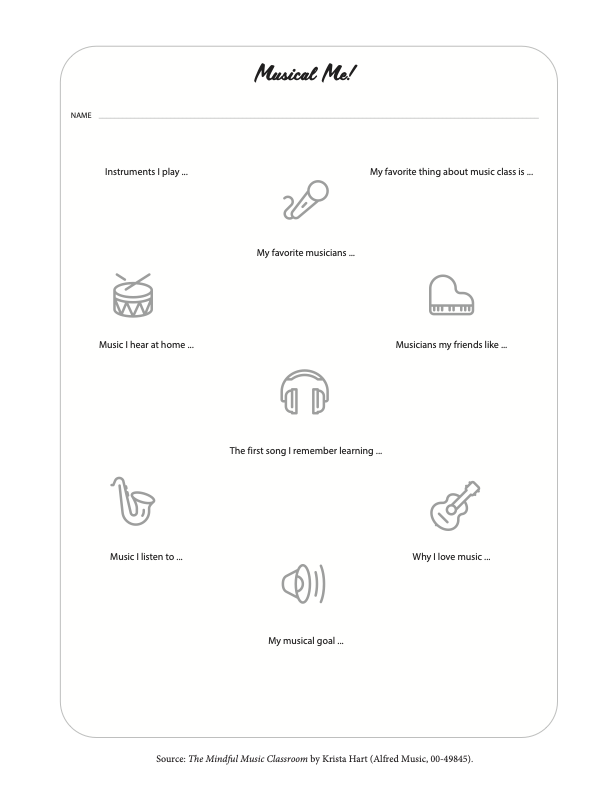
Need some ideas on how to do this? The Mindful Music Classroom has lots of practical strategies for including SEL alongside your regular musical activities. Here’s a simple way to get started—use this “Musical Me” worksheet at the beginning of the school year to invite students to tell their story as it relates to their musical experiences and preferences (self-awareness). Tailor the activity to fit your personality and the comfort level of your students by asking students to share their answers aloud, or turn it into a physical activity where students stand up and get into groups around the room based on common answers (social awareness).
People with strong social-emotional skills are better equipped to confront challenges, solve problems, maintain healthy relationships, and succeed academically, professionally, and socially. SEL provides a foundation for long-term benefits that last long after they leave your classroom.
For more social-emotional learning activities, see The Mindful Music Classroom .
