
Activities to Help Piano Students Learn to Sight-Read Successfully
January 4, 2018|
Victoria McArthur

"He can sight-read anything perfectly without practicing." "She was born with sight-reading talent."
Have you overheard these comments? Do you believe either statement can be true? Are some students born with special gifts making sight-reading easier for them? Can students sight-read without practice?
The answer is no . All pianists start at the same place, with the same tools. Sight-reading skills must be developed over time and with the right kind of practice.
Music research has also demonstrated that sight-reading is a learned skill, not an inborn talent.*
To learn to sight-read, the following must be present:
- Some time each day to specifically practice sight-reading (not performance, which is a different process)
- A reasonable practice environment — quiet, well-lit and without distractions, (ideally) using an 88-key acoustic or digital keyboard
- Sight-reading music materials chosen for their systematic progression in difficulty and their motivating qualities
"Sight-reading is largely visual pattern recognition performed with a steady pulse." Premier Piano Course Sight-Reading was written to teach pianists how to achieve this goal. The authors — piano teachers themselves — were mindful of efficiently using lesson and practice time while achieving sight-reading fluency.
The sight-reading materials in each level correlate with the equivalent level of Premier Piano Course Lesson Book, Levels 1A and 1B . There are 14 units per Sight Reading Book. Represented in each unit are five, short activities, each of which addresses an important component in sight-reading skill development (the Lesson Book correlation pages are clearly written in the upper right-hand margins). In addition, the Sight Reading Books can be used with other methods or as a stand-alone sight-reading approach.
It is suggested that pianists play one activity per practice day. Each activity is marked with a repeat sign; however, the activity should not be practiced with multiple repetitions. Play it…then leave it! Accuracy will be imperfect (that’s OK!) but will improve as sight-reading skill grows over time.
In addition, a short direction to the student precedes each sight-reading activity.
Below are examples that show samples of the five activities in each unit of Sight Reading 1A & 1B .
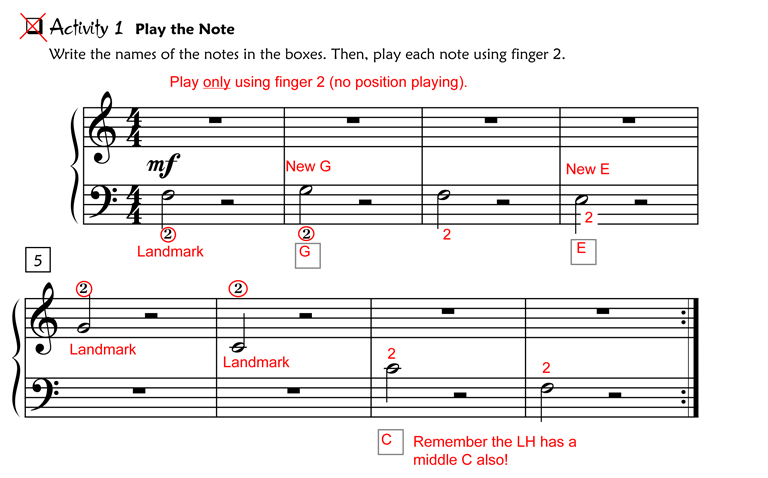
Activity 1—Play the Note
Play individual notes using finger 2 (only) to break down any reliance on playing in set hand positions.
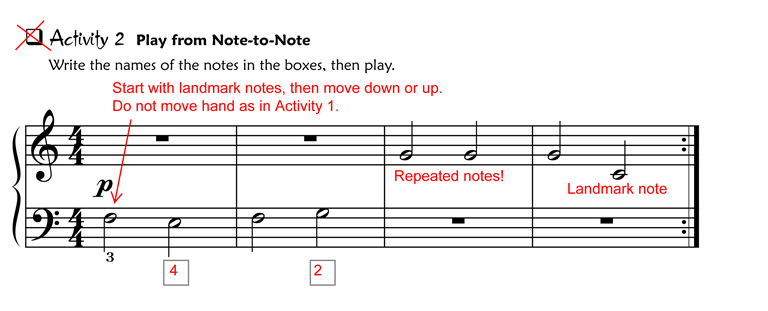
Activity 2—Play from Note-to-Note
Play patterns with steps, skips, and repeated notes as well as Landmark Notes. The goal is to play notes by using the previous note as a reference. Conventional fingering is used.
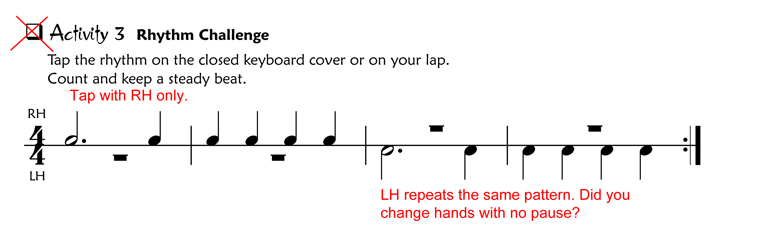
Activity 3—Rhythm Challenge
Tap rhythm patterns on the closed key cover or lap. The goal is to perform rhythm accurately while keeping a steady beat.
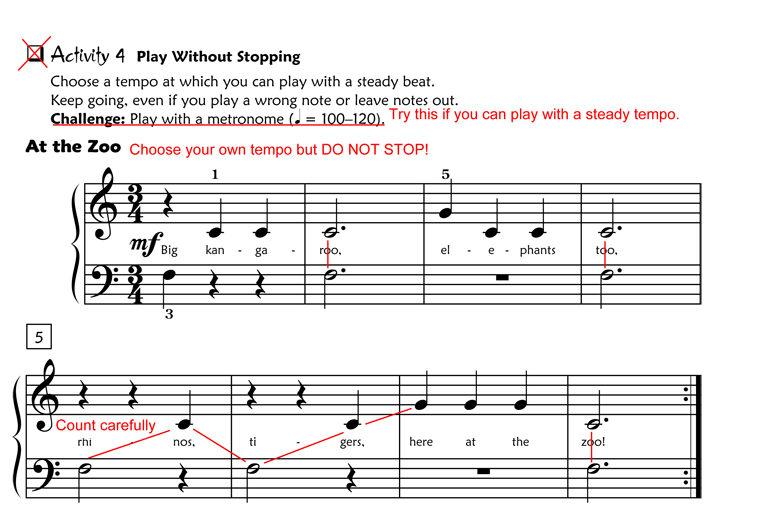
Activity 4—Play Without Stopping
Play a short piece that uses the Rhythm Challenge patterns. The goal is to keep playing without pause.
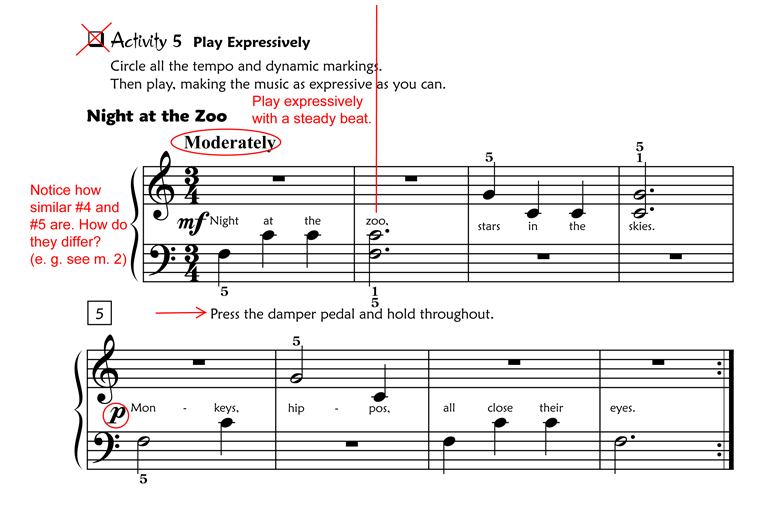
Activity 5—Play Expressively
Play a short variation of the Play Without Stopping piece. The goal is to play expressively without stopping.
Positive outcomes from using Premier Sight-Reading:
Students will:
- learn to read ahead and not halt or “back up” while playing.
- learn to keep a steady pulse and “throw away” missed or omitted notes.
- learn to pre-scan before playing, noting rhythm and note patterns, as well as marks of expression.
- improve note accuracy without cues, meaning notes at the beginning of the piece, at the beginning of new lines (systems) or new pages will be sight-read more accurately.
- develop confidence in encounters with unfamiliar music.
- enjoy their sight-reading skill, enhancing their ability to learn unfamiliar music more quickly, play duets with friends, and play for church and social gatherings, e.g.
Although sight-reading is not an inborn talent, it can definitely be developed and taught. Teachers who take time to teach sight-reading in the lesson perhaps give their students one of the greatest musical gifts of all: the ability to learn music independently — a lifelong skill! What an exciting thought!
On a practical level (especially for thirty-minute lessons), sight-reading can be heard in the first couple of minutes of each lesson. Likewise, students can dramatically improve their sight-reading skill with only a few minutes a day devoted exclusively to building sight-reading skills.
As a teacher, it is exciting to ignite, then to nurture the pleasure of sight-reading within your students, with the hope that hundreds of hours of enjoyment lie ahead for those who can work independently!
